


The 1971-D Upside-Down Eagle Kennedy Half Dollar: Hunting Rarities in Circulation & Bulk Lots
January 30, 2026The $800,000 Fingerprint: Decoding the Market Value of the 2025 Omega Privy Lincoln Cent
January 30, 2026
When Base Metal Meets Madness: A Collector’s Reality Check
What happens when a common coin suddenly becomes the talk of every collecting forum? Let’s separate fact from fiction about the 1971-D Kennedy half dollar – a coin currently sparking heated debates between hopeful sellers and skeptical numismatists.
Metal Composition: The Hard Truth Beneath the Hype
Before we dive into collectibility, let’s cut through the noise: standard 1971-D halves contain ZERO silver. Unlike their precious predecessors (those glorious 90% silver coins through 1964) or even the transitional 40% silver issues (1965-1970), the 1971-D stands as the first fully clad Kennedy half:
- Outer layers: 75% copper, 25% nickel – giving it that distinctive modern luster
- Inner core: Pure copper – no precious metal hiding in the sandwich
- Total weight: 11.34 grams – lighter than its silver ancestors
As of August 2023, the cold hard math reveals:
Copper Value: $0.0234
Nickel Value: $0.0148
Total Melt Value: Less than a first-class stamp
The “Upside Down Eagle” Enigma: Numismatic Fantasy vs. Cold Reality
That viral eBay listing (Item 335861759570) shows what some claim to be a spectacular rotated die error. But before you empty your savings account, consider what makes seasoned collectors raise an eyebrow:
- The Denver Mint pumped out over 302 million halves in 1971 – these aren’t exactly rare
- No documented rotated die errors exist in official records from that year
- The seller’s insistence on “silver content” directly contradicts historical mint records
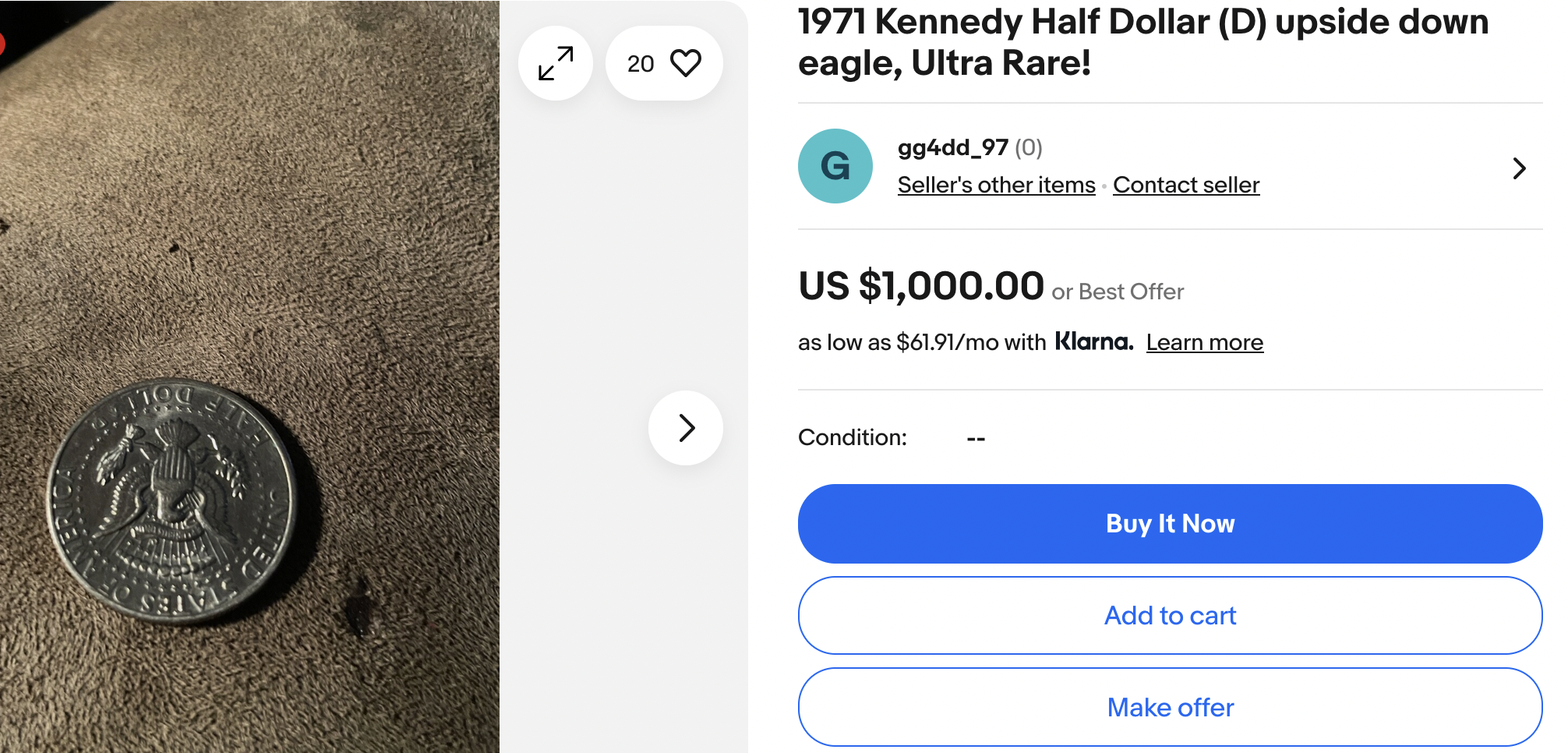
While the coin’s strike appears unusual at first glance, true rotated errors of this magnitude would show consistent misalignment across multiple specimens – something completely absent from 1971-D production runs.
Bullion Math: Why Silver Stackers Should Steer Clear
For those focused on precious metal content, the 1971-D fails every fundamental test:
| Metal | % Composition | Weight | Value |
|---|---|---|---|
| Copper | 91.67% | 10.38g | $0.0234 |
| Nickel | 8.33% | 0.96g | $0.0148 |
Now compare that to the real deal:
1964 Kennedy Half (90% silver):
0.3617 oz ASW × $24.50/oz = $8.86 intrinsic value
Collector Wisdom: Three Unbreakable Rules for Smart Stacking
That jaw-dropping $1,500 eBay asking price? It represents a 39,267x premium over melt value. Let this serve as a cautionary tale with three vital lessons:
- Trust but verify – Consult the Red Book and mint records before believing “rare variety” claims
- Focus on documented rarities – Pre-1965 silver coins and certified modern errors hold real numismatic value
- Demand provenance – No third-party grading? Walk away immediately

Historical Significance: The 1971-D’s True Legacy
While not precious, the 1971-D holds important historical weight:
- The final nail in silver’s coffin for circulation halves
- First full-year copper-nickel composition after the 1965-1970 “silver sandwich” era
- Denver’s massive mintage (302 million+) makes high-grade examples common but condition-census specimens surprisingly scarce
Authentication 101: Spotting Problem Coins Like a Pro
The forum discussion reveals textbook warning signs:
- Zero-feedback seller with suspicious backstory
- Lack of NGC or PCGS certification – essential for any claimed mega-error
- Impossible 360-degree rotation claim (dies simply don’t work that way!)
- Inconsistent surfaces suggesting possible post-mint alteration
Real-World Value: What Your 1971-D is Actually Worth
For a genuine, unaltered 1971-D Kennedy half:
- Circulated examples: Face value to 50¢ – check those pocket change finds!
- Uncirculated (MS-60 to MS-63): $1-$3 – focus on coins with original luster
- Gem BU (MS-65+): $5-$25 – premium for cameo contrast and mark-free fields
Even if this were a legitimate rotated die error (highly doubtful), the current record for clad Kennedy errors stands at $345 – not $1,500.
The Final Verdict: Collector Wisdom vs. eBay Fantasy
While we all dream of finding that once-in-a-lifetime error coin, the 1971-D Kennedy half teaches us an important lesson: true numismatic value comes from documented rarity and precious metal content, not speculative hype. As one astute forum member quipped, “This isn’t a retirement plan – it’s a 38-cent conversation piece.”
For historians, this coin represents a fascinating transition in American money. For collectors, it’s a common-date Kennedy with minimal premium unless found in pristine mint condition. And for those eyeing that eBay listing? Save your money for authenticated rarities with solid provenance. The real treasure here isn’t in the metal – it’s in the education. Now go check your Whitman folders, and happy hunting!
Related Resources
You might also find these related articles helpful:
- The 1971-D Upside-Down Eagle Kennedy Half Dollar: Hunting Rarities in Circulation & Bulk Lots – You Don’t Need a Dealer to Unearth Hidden Treasure Forget crowded coin shows—sometimes the rarest finds lurk in your poc…
- Smart Buying Guide: How to Buy 1971 Kennedy Half Dollar D Upside Down Eagle Ultra Rare Without Getting Ripped Off – Introduction For collectors pursuing this intriguing variety, mastering the hunt requires equal parts knowledge and pass…
- Crafting Controversy: The 1971-D Kennedy Half Dollar’s Jewelry Potential Examined – Not Every Coin Deserves the Ring Treatment: A Craftsman’s Truth Let’s settle this debate once and for all—no…
