


Tsar Ivan IV Wire Money: Expert Strategies for Acquiring Authentic 16th-Century Russian Silver Coins
February 7, 2026Tsar Ivan’s Silver Wire Money: Bullion Value vs Collector Premiums in 16th Century Russian Coinage
February 7, 2026
History in Your Pocket: Hunting Ivan the Terrible’s Wire Money
Forget dealer markups—some of numismatics’ greatest treasures still hide in plain sight. As a lifelong roll hunter, I’ve held history in my palm: 450-year-old Russian wire coins surfacing in dime boxes, flea markets, and overlooked estate collections. Today, we’re decoding Ivan IV’s tiny silver fragments—arguably the ultimate cherry picking challenge for sharp-eyed collectors. Let’s uncover what makes these primitive scraps some of Europe’s most fascinating circulating relics.
Revolution in Silver: Russia’s Decimal Pioneer
Before Ivan earned his “Terrible” moniker, his mother Elena Glinskaya staged a monetary revolution. Her 1534 currency reform introduced a system so advanced that 100 kopecks = 1 rouble remains Russia’s standard today. When teenage Ivan assumed power in 1547, his mints continued striking these rugged dengas and kopeks—coins so small you could lose three in a fingerprint. Yet their crude charm reveals the birth pangs of a nation.
Anatomy of a Wire Coin
- Silver wire snipped like jewelry findings
- Hand-hammered into jagged oval blanks
- Dies struck with surprising precision
- Finished pieces smaller than a baby’s fingernail (9-14mm)
Cherry Picker’s Decoder Ring: Spotting Tsarist Treasure
When sorting bulk world coins, watch for these telltale signs of 16th-century Russian silver. Remember: original patina and strike quality dramatically impact collectibility.
Obverse Clues (Bring Your Loupe!)
- Grand Duke Era (pre-1547): Horseman right, sword raised, weak lettering
- Tsarist Period (post-coronation): Lancer with spear, bolder Cyrillic legend
- Key authentication: No dragon under hooves (avoids confusion with later St. George types)
Reverse Legends – Whispers from History
Pre-1547:
КНSЬ ВЕЛIКI IВАН
“Grand Duke Ivan” – The boy ruler’s first coinagePost-1547:
ЦРЬ IКHАSЬ ВЕЛIKИ IBAN
“Tsar and Grand Duke Ivan” – Muscovy becomes an empire
Mintmarks & Measurements: Size Matters
| Type | Years | Dimensions | Weight | Mintmark (Novgorod) |
|---|---|---|---|---|
| Early Denga | 1535-1547 | 11x9mm | 0.32g | None |
| Tsarist Kopek | 1547-1584 | 14x10mm | 0.58g | АЛ (AL) – Rare variety! |
| Late Kopek | 1561-1584 | 13x12mm | 0.67g | К ВА (K VA) – Top numismatic value |
Three Prime Hunting Grounds for Wire Money
1. Bulk World Coin Bins
Dealers often overlook these Lilliputian coins in unsorted lots. My technique:
- Listen for high-pitched “ping” when sifting
- Seek irregular shapes – like flattened pumpkin seeds
- Watch for Cyrillic snippets under 10x magnification
2. Time Capsule Estates
Russian immigrant collections yield surprises. I once found seven wire coins in a Brooklyn samovar! Check:
- Cigar boxes labeled “foreign scrap”
- Orthodox prayer book gutters
- Pre-1917 photo albums (coins as page markers)
3. Unexpected North American Sites
Yes, Ivan’s coins reached the New World:
- Alaska’s Russian Orthodox churches (offerings)
- Great Lakes fur trade sites
- WWII vet collections (Eastern Front souvenirs)
Living History: Coins in Mouths & Whistling Curses
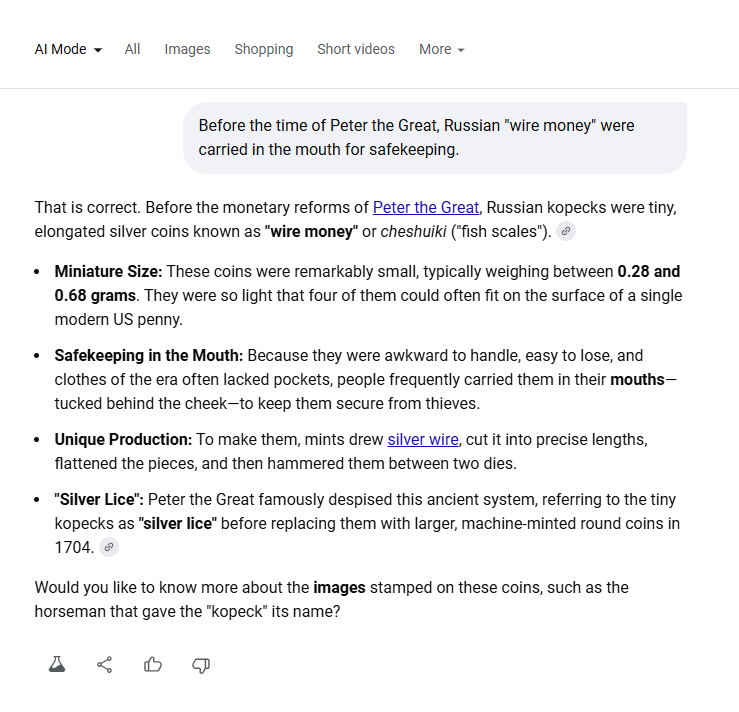
Forum member @Samets revived a forgotten truth: Russian peasants stored wire money in their cheeks as anti-theft devices. This spawned the superstition that whistling indoors would “blow away” your hidden wealth—a real risk when coins sat literal inches from your lips!
“These coins weren’t just currency—they were survival. Lose one, and you lost a day’s wages. No wonder whistling became taboo!”
Current Market: What’s That Tiny Silver Worth?
- Worn Denga: $15-$50 (common but historically vital)
- AL Mint Kopek: $75-$200 (better eye appeal)
- K VA Mintmark: $100-$300 (rare variety territory)
- EF Survivors: $500+ (mint condition is near-mythical)
Pro Tip: Novgorod mintmarks (АЛ) command premium value. Last month, a crusty AL kopek with solid provenance sold for $420 at auction.
Handling History: Preserving Delicate Legacies
- Use archival-quality 1″x1″ flips – standard 2x2s swallow them whole
- Never remove natural patina – that mellow tone is centuries in the making
- Photograph beside a dime for scale, with oblique lighting to show luster
Why Collect Ivan’s Pocket Change?
These fingernail-sized silvers embody Russia’s transformation from medieval duchy to empire. Like Eisenstein’s Ivan the Terrible coronation scene—where nobles rain coins at the Tsar’s feet—each kopek witnessed terror and triumph. For modern collectors, finding one is like discovering a dropped stitch in history’s tapestry. So next time you’re elbow-deep in a bulk bin, remember: beneath those common 20th-century coins might lie a hand-struck relic from the Kremlin’s most infamous ruler. Now that’s numismatic value you can taste—quite literally, given where peasants kept them!
Related Resources
You might also find these related articles helpful:
- Tsar Ivan IV Wire Money: Expert Strategies for Acquiring Authentic 16th-Century Russian Silver Coins – The 16th-Century Russian Wire Money Collector’s Handbook There’s nothing quite like holding a piece of Tsar …
- Crafting History: Assessing Tsar Ivan IV’s Silver Wire Money (1547-1584) for Jewelry Potential – The Artisan’s Dilemma: When Ancient Coins Meet Modern Craftsmanship Not every historical treasure belongs on a jew…
- Preserving History: Essential Care Guide for Ivan IV’s Silver Wire Money (1547-1584) – As a collector who’s held Ivan IV’s wire money in trembling hands, I know the heartbreak of seeing history d…
