


Preserving Rainbow Riches: Expert Conservation Strategies for the Record-Setting 1881-S Morgan Dollar
January 17, 2026Smart Buying Guide: How to Buy 1881-S Morgan Dollar Rainbow Toner Without Getting Ripped Off
January 17, 2026
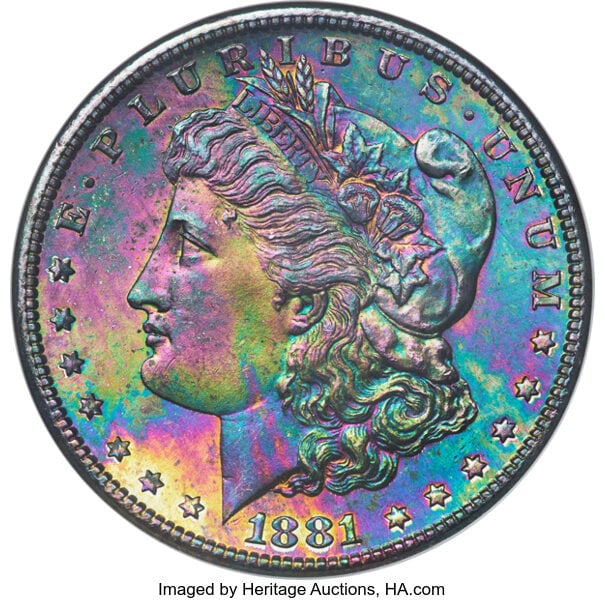
When an 1881-S Morgan dollar shattered records at $43,932 in Heritage’s FUN Signature Sale, collectors gasped—but jewelry makers saw a different kind of potential. Let’s explore why transforming this numismatic treasure into wearable art sparks passionate debate, examining its silver content, structural integrity, and ethical implications for crafting.
The Allure of Rainbow Toners
The star of this sale—an 1881-S Morgan graded NGC MS67—represents both the pinnacle of collecting desire and a complex dilemma for artisans. While numismatists marveled at its eye-popping price, metalsmiths faced a sobering truth: though its 90% silver composition makes it technically ideal for jewelry, destroying such a pristine example feels almost sacrilegious. The coin’s breathtaking rainbow toning, that magical interplay of violet, gold, and blue hues, transforms it from mere precious metal into a historical artifact.
“People have laughed at what truly special toned Morgans will realize for as long as I’ve been collecting. IIRC, the Moose brought that $40k level over two decades ago.”
Historical Context
This particular Morgan dollar carries unique baggage. During the late 1980s collecting frenzy, telemarketers flooded the market with 1881-S specimens, creating such oversupply that prices cratered by 83-85% within years. This history of boom and bust lingers like patina on bronze—even today’s record-breaking sale can’t erase the skepticism of veteran collectors who remember the bust.
Metal Composition & Crafting Viability
Silver Content Analysis
Crafted from 90% silver and 10% copper, this Morgan’s alloy mirrors sterling silver’s properties—making it ideal for jewelry in theory:
- Malleability: Soft enough to shape into rings without cracking
- Tarnish Resistance: Copper content helps preserve silver’s natural glow
- Structural Integrity: Perfect hardness (2.5-3 Mohs) for holding intricate details
Toning Durability Concerns
That mesmerizing toning—whether nature’s work or accelerated through methods like:
“Place a clear glass CONVEX small bowl over the coin and let sit for 6+ months”
creates an insurmountable barrier. The rainbow effects live in mere microns of surface metal. Reshaping the coin would shatter its iridescent patina—the very feature that justified its five-figure premium. The delicate color gradients near Liberty’s brow would fracture unpredictably under a jeweler’s hammer.
Design Elements for Jewelry Adaptation
Obverse Considerations
Lady Liberty’s portrait offers both promise and challenges:
- High Relief: Creates dramatic shadows when domed—perfect for cameo effects
- Focal Points: Star clusters and date stamp wrap elegantly around band edges
- Problem Areas: Forum members spotted “micro-weakness near Liberty’s nose bridge”—flaws that stretch into glaring imperfections
Reverse Potential
The eagle reverse provides better geometry for metalwork:
- Outspread wings naturally follow a ring’s circumference
- Central shield balances weight distribution during wear
- Lettering survives edgework intact—a rarity in coin jewelry
Aesthetic & Market Realities
The Price Problem
At nearly $44,000, this specimen exists in “museum-grade preservation territory”. As one forum member astutely observed:
“I could assemble a very nice collection with that kind of money.”
Transforming it into jewelry would require pricing finished pieces above $60,000—commercial suicide when common-date Morgan rings sell for $300-800. The math simply doesn’t justify sacrificing such a rare variety.
Alternative Suggestions
For similar visual impact without numismatic guilt:
- 1922-1925 Peace dollars (abundant in MS63-64 with great luster)
- Cull Morgan dollars with intact centers but impaired collectibility
- Modern .999 silver rounds featuring deep cameo strikes
Preservation vs. Transformation
This heated collector-artisan debate crystallizes in our comparison table:
| Factor | Collector’s Perspective | Artisan’s Reality |
|---|---|---|
| Toning Patterns | Primary value driver | Destroyed during forming |
| Surface Quality | NGC MS67 grade commands premium | Irrelevant after modification |
| Mint State Surface | Bag marks tell its story | Adds “character” to jewelry |
Conclusion: A Collector’s Treasure, Not Artisan’s Resource
While the 1881-S Morgan’s silver content and diameter make it physically suitable for jewelry, its astronomical numismatic value and status as a condition rarity remove it from practical consideration. The heart-stopping bidding war—reaching nearly 100x a standard MS67 Morgan’s price—confirms this coin’s destiny lies behind protective glass, not on someone’s finger. For artisans seeking magnificent silver, common-date Morgans with impairment-free centers offer identical material properties. Let this rainbow-toned beauty remain what it was meant to be: a preserved piece of history, not raw material.
“As someone who checked out the coin at lot viewing… it is an awesome coin and whoever the top 2 bidders are, I hope they leave a few monsters for the rest of us.”
Related Resources
You might also find these related articles helpful:
- The $44,000 Rainbow: Grading the Record-Setting 1881-S Morgan Dollar That Defied Market Expectations – Condition Is King: Anatomy of a Record-Breaking Morgan Dollar In our world of numismatics, condition isn’t just im…
- The $44,000 Rainbow: Decoding the Record-Shattering Sale of an 1881-S Morgan Dollar – Beyond the Price Guide: Unlocking True Numismatic Value What transforms a common date silver dollar into a $44,000 shows…
- 1795 Flowing Hair Half Dollar: Evaluating Market Realities for a Holed & Plugged Early American Rarity – Beyond the Price Guide: Why This 1795 Half Dollar Defies Simple Valuation Put down your coin catalogs, fellow collectors…
